
Kyiv Polytechnic representative joins online workshop on science diplomacy
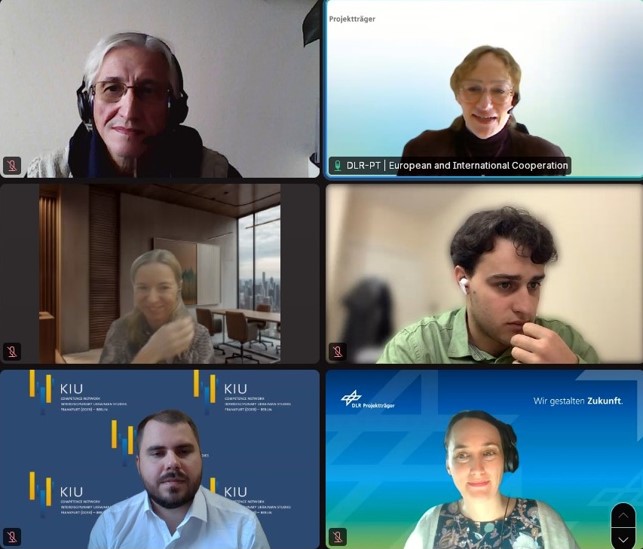
On 5 November 2026, a representative of the International Collaboration Department at the Igor Sikorsky Kyiv Polytechnic Institute joined the LUKE (Linking Ukraine to the ERA) Project Online Workshop entitled “Connecting Voices: Building Ukraine’s Science Diplomacy Ecosystem in Europe”
This interactive workshop explored the potential of science diplomacy for Ukraine and its stakeholders – from building sustainable bridges between research communities, policymakers and foreign policy actors to integrating Ukrainian institutions into the wider European science diplomacy landscape. Its programme featured leading voices from Ukrainian academia, European policy advisory bodies, and diaspora networks to explore best practices, current frameworks, and practical entry points for collaboration.
Henriette Kirch, Scientific Advisor at DLR Projektträger, and Yevheniia Polishchuk, Cofounder of the Ukrainian Science Diaspora, welcomed participants and provided opening reflections. Henriette Kirch underscored that the main purpose of the LUKE project is to strengthen Ukraine’s Research and Innovation System.
Stella Reschke, Senior Scientific Advisor at DLR Projektträger, gave the presentation themed “European Science Diplomacy: State of Play and Opportunities for Ukrainian Stakeholders.” She found a receptive audience for her key messages: research and innovation have become a geopolitical currency, science must learn to navigate tricky geopolitical waters, diplomats and scientists need to make an effort to understand each other. Maximising the impact of the Union’s research and innovation potential for the pursuit of peace, protection of human rights, multilateralism and a rule-based international order is one of the main objectives of EU Science Diplomacy.
In addition, Stella Reschke suggested joining the new Science Diplomacy Hub (https://hub.science-diplomacy.eu/) that hosts 10 Working Groups bringing together researchers, diplomats, policymakers, and other stakeholders around pressing themes in contemporary science diplomacy.
Prof Igor Lyman, Coordinator of International Relations at Berdyansk State Pedagogical University and Co-founder of Ukrainian Science Diaspora Initiative, presented the Institute of International Scientific Ambassadors, initiated by the Ministry of Education and Science of Ukraine. He outlined a procedure for receiving certificates of scientific ambassadors.
Providing his presentation “Exploring Ukrainian Studies as a tool of Science Diplomacy,” Vitalii Suprun, Research Fellow at KIU – Competence Network Interdisciplinary Ukrainian Studies initiated and managed by Germany’s European University Viadrina in Frankfurt (Oder), noted that more than 160 Ukrainian and Crimean Tatar Studies centres are currently operating in some 30 countries. Since 2022, new partnerships, including the Global Coalition of Ukrainian Studies (2024), have expanded the field and challenged Russia-centred regional frameworks. He drew attention to the fact that the win-win Ukrainian Studies tool improves international understanding of Ukraine through rigorous, interdisciplinary and locally grounded research, while connecting Ukrainian and European universities, researchers and institutions in sustained collaboration.
Miguel Luque Cañete, Co-Director of the Society of Spanish Researchers in the United Kingdom (SRUK/CERU), presented the role of scientific diasporas in science diplomacy, particularly the SRUK/CERU that numbers 330 members in the UK connecting 700 people or so. He also pointed out the CONNECTS-UK pan-EU collaborative platform launched in 2024 with over 10 EU scientific diaspora associations adding up to about1,500 participants to strengthen EU-UK research collaborations and the EU scientific diaspora. In this context, Miguel Luque Cañete highlighted examples of success, such as the Austrian-UK Science Alliance and the Ukrainian British Academic Alliance whose aim is to unite the efforts of Ukrainian scientists abroad of different waves of migration for further joint research projects, as well as to develop tools for their support programmes and their return to Ukraine.
Special thanks are due to Henriette Kirch and Yevheniia Polishchuk for moderating the workshop, including its lively Q&A session.


You May Also Like

Open Science for HEIs: Kyiv Polytechnic showcases institutional toolkit at Ljubljana seminar
16.06.2025
Kyiv Polytechnic Rector ranks fifth on 100 Most Influential Ukrainians List
10.09.2026