BUP webinar explores how SSbD can guide development of safer, circular materials
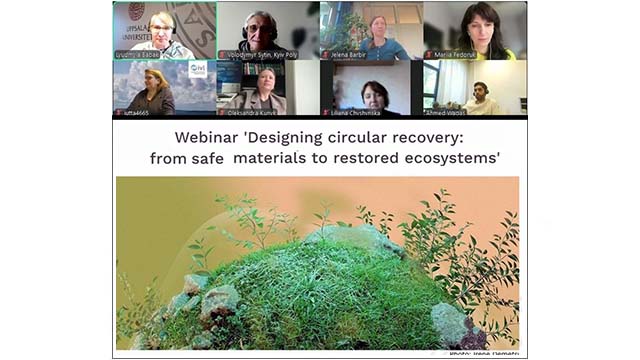
On 1 October 2026, a representative of the International Collaboration Department and the National Contact Point (NCP) of Horizon Europe for Cluster 5 “Climate, Energy and Mobility” at the Igor Sikorsky Kyiv Polytechnic Institute joined the sixth webinar marking the 35th anniversary of the Baltic University Programme (BUP), dedicated to sustainability and the 10 BUP themes. Held under the theme “Designing circular recovery: from safe materials to restored ecosystems,” this webinar explored how Safe and Sustainable by Design (SSbD) can guide the development of safer, circular, and bio-based materials. More than 58 people signed up for the event.
The purpose of the webinar was to bring together approaches for assessing chemicals and nanomaterials with innovations in recyclable biopolymers, bio-based plastics and next-generation textile chemistries. The event also highlighted how these approaches can contribute to ecosystem and soil restoration, including in contexts affected by war, by linking material innovation with circularity, environmental safety and resilient recovery.
The webinar included four presentations followed by the discussion session. The event opened with welcoming, introductory remarks by Lyudmyla Babak, BUP Project Coordinator, and Prof Walter Leal, Head of the Research and Transfer Centre ‘Sustainable Development and Climate Change Management’ at the Hamburg University of Applied Sciences (HAW Hamburg).
Dr Jelena Barbir at HAW Hamburg and Arantxa Ballesteros, Project Coordinator and SSbD expert at the ITENE research centre, gave the presentation entitled “Towards the Next Generation of Safe, Circular and Bio-based Textiles: The TEX4GREEN Project.” Their presentation addresses, via the TEX4GREEN project, how the textile industry can reduce its dependence on fossil-based chemicals while improving safety, sustainability, and circularity.
Specifically, Jelena Barbir drew attention to key environmental impacts, noting that dyeing clothes accounts for 20% of global clean water pollution when toxic chemicals leak into rivers, while making and shipping clothes causes 8% to 10% of global carbon emissions, which is more than all international flights and shipping combined. Therefore, the goal of the project is to develop, scale up and demonstrate bio-based and SSbD solutions as alternatives to hazardous fossil-based chemicals in the textile industry. Presenting a TEX4GREEN solution, Arantxa Ballesteros underscored that feedstocks are 100% renewable and of secondary bio-based origin.
A presentation provided by Dr Ahmed Waqas at the Technical University of Denmark (DTU) introduced the CheMatSustain project and DTU’s work on the safety and sustainability assessment of chemicals and nanomaterials.
Jutta Hildenbrand at the IVL Swedish Environmental Research Institute presented the INSOIL project, which is intended to develop soil-regenerative biopolymers from organic waste that are fully recyclable and support carbon-neutral production. Scheduled until May 2029, this project sets the goal of replacing widespread single-use agricultural plastics. One of the key takeaways stressed by Jutta Hildenbrand was that SSbD helps innovators to create safer, more sustainable chemicals and materials for the future.
In her presentation, Dr Maria Fedoruk at HAW Hamburg highlighted the urgent need for safe, sustainable, and circular solutions for post-conflict recovery, with a particular focus on ecosystem restoration and soil rehabilitation in war-affected areas. In particular, she raised concerns about the Putin’s ecocide in Ukraine, emphasising that 23% of its total territory is contaminated with russian high explosives. It is also important to note that Maria Fedoruk is the Coordinator of the Ukraine Nature Network platform designed to congregate and disseminate information on environmental projects in Ukraine, in the context of the russian sinister war against this country.

You May Also Like
New Course from the Baltic University Programme: Introduction to Education for Sustainable Development (ESD)
15.11.2024