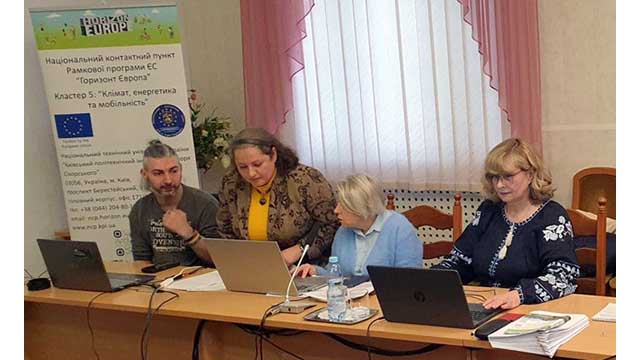
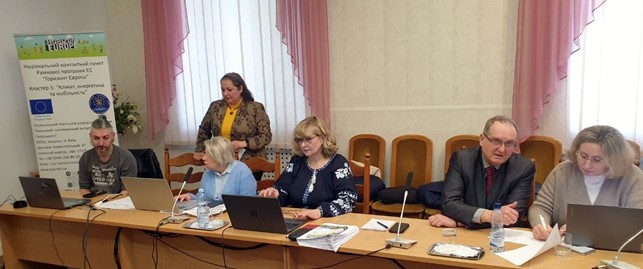
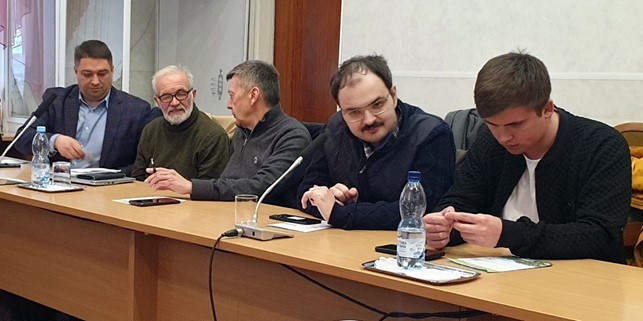
Organised by the Centre of Research on Intellectual Property and Technology Transfer at the National Academy of Sciences of Ukraine (NASU), in collaboration with three National Contact Points of the Horizon Europe research and innovation programme, a training seminar took place in Kyiv on 30 April 2026. The theme of the seminar was “First Steps towards Participating in Horizon Europe Programme: From Registration to Formulation of Project Concept”.
Designed for those just beginning their journey to Horizon Europe, the seminar covered the key stages, from an introduction into the programme to the drafting of a project proposal.
The event was held in a hybrid format — online via Zoom and in person in the NASU Grand Conference Hall — which enabled to draw a large attendance, including researchers, educators, and representatives of the innovation sector from various regions of Ukraine.
In the opening presentation, Karyna Shakhbazian, Head of the National Contact Point (NCP) for “Legal and Financial Aspects,” gave an overview of the Horizon Europe programme: its structure, types of projects, eligibility criteria and funding. Special attention was paid to opportunities available to Ukrainian institutions.
The practice session on the first steps forward to participation was conducted by Maryna Gorokhovatska, expert at the NCP for “Research Infrastructures” and Ukraine’s representative to the EU Programme Committees. The attendees learned how to use the EU Funding & Tenders Portal, how to register an organisation, obtain a 9-digit Participant Identification Code (PIC), define the role of the Legal Entity Appointed Representative (LEAR) in the appointment process on the portal, and search fruitfully for partners. This knowledge and understanding were solidified through practical exercise tips.
Sergiy Shukayev of the NCP for Cluster 5 “Climate, Energy and Mobility,” based at the Igor Sikorsky Kyiv Polytechnic Institute (KPI), provided a presentation on the next stage – developing a project concept. Participants considered how to properly formulate project objectives, propose creative solutions, justify the expected impact and ensure the quality of outcomes.
Angela Piatova, Head of the KPI-based NCP for Cluster 5 “Climate, Energy and Mobility,” provided further insights into the structure and requirements of project applications. She detailed the sections of an application, evaluation criteria, common errors and the usual pitfalls. Participants also did a practical exercise to solidify their understanding of the material.
The most exacting issues of budgeting were highlighted by Tetiana Popova, Head of the NCP “Legal and Financial Aspects”. She explained the basic principles of cost planning, the structure of the budget, and requirements for sound financial justification, followed by a practice session as well.
Giving the seminar’s agenda a plug, Anton Nanavov, Deputy Head of the Research Department for International Affairs at Taras Shevchenko National University of Kyiv (KNU), shared the experience to make successful applications for funds from Horizon Europe grant funding. Specifically, he noted that on the average KNU researchers submitted between 45 and 50 applications a year, and 10% of them were successful. By comparison, KPI researchers submit annually some 60 applications, with one in 15 being successful, according to Professor Shukayev.
The seminar concluded with a Q&A session, offering participants the opportunity to get individually further clarifications and good tips from the experts.
Overall, the event marked an important step in raising awareness among the Ukrainian scientific community in terms of the opportunities offered by Horizon Europe and facilitated their developing practical skills in drawing up competitive project proposals