
CESAER Members discuss future of STEM education in Europe
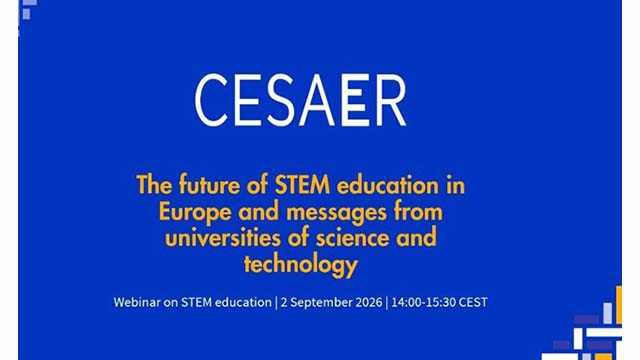
On 2 September 2026, the CESAER Task Force European Higher Education organised a high-level webinar to discuss the future of STEM education in Europe. The discussion brought together leadership-level perspectives from CESAER Members on the main challenges and changes needed across the STEM education pathway.
Strengthening STEM education and advanced skills is high on the EU agenda. The webinar has been organised in view of the Irish Presidency’s planned Council conclusions on STEM education, which are expected to consider how STEM learning can be strengthened across different levels and types of education and training, including in support of the green and digital transitions.
The moderated discussion focused on identifying common messages and possible CESAER recommendations. It helped develop possible CESAER recommendations for European and national policymakers and inform CESAER input to related EU processes, including the European Skills High-Level Board and the STEAM Executive Panel, which advise the European Commission on future skills needs and priorities for STEM and STEAM education.
Presenting shortly the political road map, Touko Närhi, CESAER Advisor for Benchmark and Higher Education, observed that the Irish Presidency is preparing Council conclusions on STEM education and training for November 2026.
Geir Egil Dahle Øien, Pro-Rector for Education at the Norwegian University of Science and Technology (NTNU), gave a presentation on an institutional perspective on upcoming Council’s conclusions on STEM education. As far as strategies for strengthening STEM are concerned, NTNU recommends to focus on cross-sector collaboration, coordination and resource sharing, among other things. In particular, his presentation pointed to the conclusion that major technological developments (AI) and sustainability competences should be integrated into study programmes.
According to the NTNU Pro-Rector, STEM education needs to be aligned with ethical, technological and ecological imperatives, increasing the focus on transferable imperatives. NTNU’s preliminary recommendations include an increase in European cooperation towards coherent, motivating educational pathways, and design approaches to early interventions towards prospective students.
In his presentation on STEM education, Hans Hellendoorn, Vice-Rector for Joint Education at Netherlands’ Delft University of Technology (TU Delft), emphasised the point that students have to know more about sustainability and climate change while the society and industry are changing rapidly. Specifically, the competencies expected of future STEM engineers, he noted, should embrace knowledge of AI, digital skills, entrepreneurship, and climate. “We will need to put extra elements in our curriculum,” he said. “And they should have knowledge about AI, open data, entrepreneurship, and climate.”
Mariusz Kaczmarek, Vice-Rector for Education at Poland’s Gdańsk University of Technology, provided a presentation on “making STEM education engaging, inclusive and future-ready”. Presenting elective courses as an instrument of flexibility, he highlighted interdisciplinary university electives that enable students to work across fields and understand wider technological, societal and environmental contexts. He also explained that electives may provide faster access to emerging topics such as offshore wind energy, hydrogen technologies, and climate adaptation.
In conclusion, Mariusz Kaczmarek stressed that the most important change is to move from relatively rigid, discipline-based programmes towards flexible, challenge-driven STEM education that combines strong scientific foundations with continuous curriculum renewal. Students should learn through authentic problems related to clean energy, cybersecurity, health, societal resilience and maritime technologies, working in interdisciplinary teams with researchers, companies and public institutions. “It is expedient to show students possibilities for self-development and importance of STEM subjects for society and environment,” he said.
Special thanks are due to Justyna Lubośna, Co-Chair of the Task Force European Higher Education, for moderating the discussion.

You May Also Like

Kyiv Polytechnic representatives join key stakeholder groups for panel debate on next Horizon Europe programme
24.06.2026
CESAER Members Discuss Principles for Performance Assessment for European University Alliances
13.03.2024