
International partners visit Kyiv Polytechnic to implement learning programme in humanitarian demining
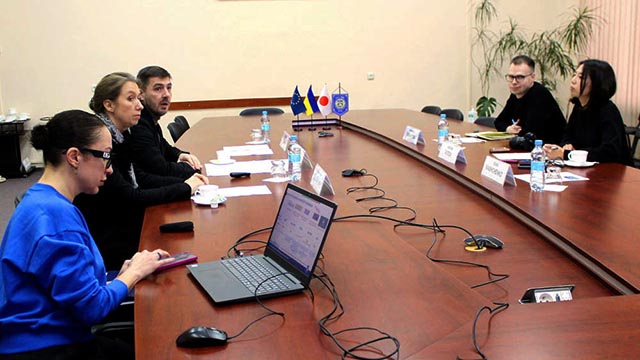
On 16 December 2025, Andrii Shysholin, Vice-Rector for International Relations of the Igor Sikorsky Kyiv Polytechnic Institute, together with Oksana Vovk, Director of the Kyiv Polytechnic’s Institute of Energy Saving and Energy Management (IEE), and Kateryna Lugovska, Director of the Ukraine-Japan Centre affiliated to this university, met with Mykhailo Turianytsia, Communications Specialist at the United Nations Office for Project Services (UNOPS), and Narumi Tateda, a journalist representing Japan’s Kyodo News Agency.
After Andrii Shysholin provided a presentation on the university to the guests, the conversation was framed by the implementation of a learning programme in humanitarian demining at the IEE. Oksana Vovk described this programme in details, joined online by IEE students currently getting education in this field. The students spoke about their studies and their reasons for choosing this particular specialisation.
The dialogue with the students generated keen interest among the guests. They asked about students’ reasons for choosing this specialisation, how their parents responded to their decision, as well as how the students envision their career prospects in this field. There is no need to recount young participants’ answers at length, as the leitmotif running through their words was patriotic views and the acknowledgement of a need for this profession in Ukraine. It is worth noting too that the IEE students demonstrated a high level of proficiency in English throughout the conversation.
“They are truly motivated young people, a new generation of engineers who will have unique technical expertise that will empower them, first, to succeed in their future careers and, second, to cope with formidable yet vital tasks, both in terms of land decontamination and the application of environmental protection technologies,” commented Oksana Vovk. “And the fact that they all have a very good command of foreign languages is a boon for them, offering an opportunity to represent Ukrainian youth abroad, because young people always turn a keen ear to their contemporaries.”
The discussion also touched upon issues related to training aids and appliances for the new learning programme. According to the IEE director, the UNOPS has already supplied gratis Kyiv Polytechnic with some items of equipment. “We use it [equipment] to train our students in humanitarian demining, as well as to conduct research in the field of landmine safety,” Oksana Vovk explained.
“The function of our Office is to provide targeted assistance within clear-cut projects to key players in Ukraine in order to promote its socio-economic development, which is one of the missions of the UN. With funding from the European Union, we procure and deliver equipment that will be used for effective instruction of students, training, and the honing of their skills,” Mykhailo Turianytsia told Dmytro Stefanovych, Editor in Chief of the Kyiv Polytechnic Newspaper. “The price of the equipment we plan to deliver totals approximately 1.5 million hryvnias.”
He added that this programme could potentially be continued, the more so as Kyiv Polytechnic is seen by international partners as a leading educational and scientific institution, as well as a training centre in the field of mine action and humanitarian demining.
The participation of a representative from one of Japan’s leading news agencies in this meeting was also significant. Oksana Vovk noted this point: “It is very good that the Japanese side takes interest in this specific field at KPI. This is yet another opportunity to inform the world about what is really happening in Ukraine.”
At the same time, the country is facing serious challenges, as the amount of work to clear mine-affected regions in whole is huge, therefore it should be done as efficiently as possible, with the maximum use of the cutting-edge technological solutions. The specialists being trained at Kyiv Polytechnic of late are not so much field deminers, but primarily professionals who will ensure the effectiveness of demining, make this system more productive by developing innovative tools and techniques.
During their visit, the guests also toured the Ukraine-Japan Centre located in the university Scientific and Technical Library. Kateryna Lugovska detailed its activities, programmes, and events. Yet even without words, much spoke for itself: the well-thought-out design of space, the exhibition hall, the Ukrainian-Japanese library (undoubtedly the best of its kind in Ukraine), the Japanese contemplative garden characterised by the careful arrangement of natural stones, the room built for the chanoyu (tea ceremony), classrooms for learning Japanese language and the traditional logical games shogi and go.
The visit concluded with a tour of the IEE laboratories, which are used for training bachelor’s and master’s degree students in mine action and humanitarian demining, including a demonstration of the equipment received by the institute under the UNOPS assistance programme.
P.S.
UNOPS is a United Nations agency that provides partners with procurement, infrastructure and project management services. It has been operating in Ukraine since 2016. In particular, UNOPS helps this country to achieve tangible results in sectors such as energy, education, and mine action.
Kyodo News is one of Japan’s largest and most influential independent public news agencies with a focus on Japan and Asia, delivering important news to Japanese and international media. It provides wide coverage of events in Ukraine as well.


You May Also Like
