Graduate’s voyage from Kyiv Polytechnic to Vernadsky base in Antarctica
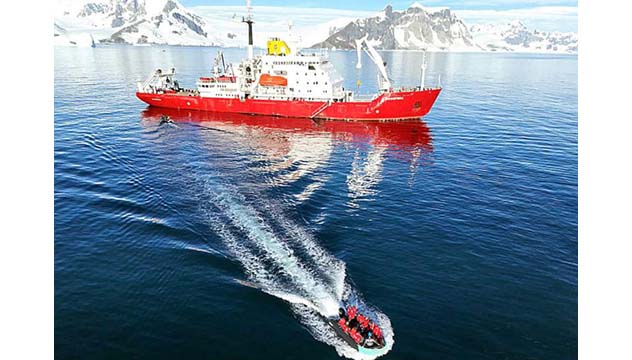
The 31st Ukrainian Antarctic expedition (UAE) has recently begun its work at the Academician Vernadsky Station. This expedition team has replaced their colleagues from the 30th UAE and will remain there for 12 months. Among the expedition members is Oleksandr Matsibura, a graduate of the Igor Sikorsky Kyiv Polytechnic Institute, who holds a responsible job as a system administrator with the Antarctic research base. This will be his second Antarctic winter at Ukraine’s Vernadsky base.
“This year we have marked the anniversary of the presence of independent Ukraine in Antarctica. It has been 30 years since Britain transferred its Antarctic research station to us, and we are keeping our own chronicle of polar science,” said Yevhen Dykyi, Director of the National Antarctic Scientific Centre in Kyiv, seeing the UAE team off. “It is vital that we maintain the continuity of our research and develop new areas to explore, even in the midst of the terrible full-scale war.”
On the eve of his departure, Nadiia Libert, Senior Editor of the Kyiv Polytechnic Newspaper, spoke with Oleksandr, a 2017 graduate of the Faculty of Chemical Technology, about his work, daily routine, and his time at the university. The interview has been edited for brevity and clarity.
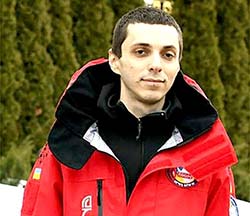 He was tired and busy, yet attentive and filled with very positive energy. According to the Kyiv Polytechnic graduate, the organisation of the teaching process at the then Department of Cybernetics of Chemical Technology Processes facilitated the practical application of the knowledge acquired by seniors. Thus, Oleksandr began working as a cable systems installer for a video surveillance company while still in the fifth year of his university studies, and as a connectivity engineer for an internet company later on.
“My voyage to Antarctica began as recently as 2019,” he says. “I applied for a job on a competitive basis, but unfortunately failed for lack of the necessary experience. My next try, in 2024, was successful, and I joined the 29th UAE team.”
The polar researcher speaks prosaically about his work at the base: “For nearly seven to eight months, the base and the team are completely isolated from the outside. You can only rely on your own skills and those of your colleagues.”
“In other words, you won’t be able to pop down to a shop or meet new people,” he explains with a smile. “At the base, a systems administrator has no days off – you work seven days a week, plus a lot of additional duties shared with the whole team.”
Asked why he went on an expedition again, given that working conditions are abnormally harsh there, Oleksandr said succinctly: “Antarctica has captivated me, especially by its nature. Also, it’s a chance to contribute to Ukrainian science.”
The conversation then returned to Igor Sikorsky Kyiv Polytechnic Institute. “I am grateful to Kyiv Poly for the experience, the knowledge, and the friends it gave me. The university helped me to learn how to find and glean the information I need, and how to discover new things,” says Oleksandr Matsibura. “I would advise students not to be afraid of difficult paths, but to develop all round – and, of course, to try to put the theoretical knowledge they’ve gained into practice.”
P.S. The British Antarctic Survey, a component of the Natural Environment Research Council, decided it no longer needed its Faraday base, on a rocky island on the Antarctic peninsula, 700 miles south of Tierra del Fuego. It was sold to Ukraine for a symbolic £1 in 1996 and renamed after the Ukrainian scientist, Volodymyr Vernadsky. The only condition attached to the Vernadsky base was that the Ukrainian polar researchers continued to monitor the weather, which has been recorded every three hours at the site since 1947.