
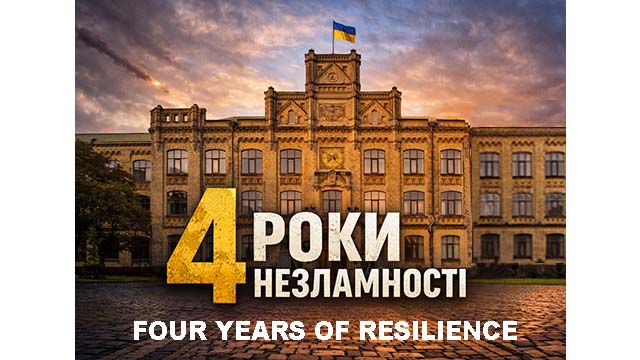
Endurance, high resolve, resilience: how four years of war have changed Kyiv Polytechnic
Reflecting on the fourth anniversary of Russia’s full-scale invasion of Ukraine – the so-called “special military operation” that was supposed to last mere days, Andrii Shysholin, Vice-Rector of the Igor Sikorsky Kyiv Polytechnic Institute, wrote in LinkedIn post that the war burst into university life all at once. At first, it was a chain of urgent decisions: evacuating international students, nonstop phone calls, and responsibility for the people who could not be neglected even for an hour. Strategy, he recalled, came later. In those days, there was only action.
All university teaching moved online almost immediately – classes from air raid shelters, from temporary housing, and from abroad. Plans became blurred as the words “semester” and “academic year” lost their familiar meaning. Alongside this, dumb despair began to grow: not panic, but a tired uncertainty.
In time, Andrii Shysholin wrote, the war became a fixture of daily life. Enemy drones were flying around the capital city of Kyiv, ballistic missiles left no time to react, and air raid alerts shattered the academic day into fragments. Work and studies continued between air strikes, news updates, and short messages of colleagues asking “are you okay?”
At the same time, the sense of loss was deepening – first, through only individual names, then through students, a teaching staff, and alumni who had recently been part of university life. Andrii Shysholin noted ruefully that a list of the fallen kept growing, and the war did not seem like a vague abstraction.
Against this backdrop, however, support emerged from partners, colleagues abroad, friendly universities: messages of solidarity, shared decisions, and academic solidarity programmes, which were incredibly sustaining. Recovery and adaptation followed: damaged buildings were repaired, shelters built, and new forms of support for students and the teaching staff designed.
About a year later, a cautious return to Ukraine began despite the risks. Some faculty members returned from abroad and Kyiv Polytechnic resumed in-person classes for the first time since the start of Putin’s sinister invasion. Lecture halls filled again, students always pricking up their ears to air-raid sirens. There was a slender hope that the end of the war might be closer.
The pulse of developments shifted again. Andrii Shysholin wrote woefully in his post that partners gradually paid less attention, fatigue with Ukraine deepened noticeably, and political fluctuations revived uncertainty. The end of the war disappeared from the horizon and became an open question once more.
As if to rub salt in the wound, then the hardest winter descended without stable supplies of electricity, water and heating. The university was literally operating in darkness and severe cold, relying on generators, power banks, and flashlights. As the Vice-Rector put it, Kyiv Polytechnic staff taught and laboured whenever possible, pausing only for a brief, much-needed respite.
Today, he wrote, the university harbours no illusions about quick solutions to the current war and guaranteed global attention. In spite of difficulties, Kyiv Polytechnic has not disappeared even in the darkest moments of Putin’s evil, nor has it surrendered its mission under fire, nor has it lost its purpose.
In conclusion Andrii Shysholin expressed his gratitude to the partners and friends who have stood with Igor Sikorsky Kyiv Polytechnic Institute from the first days of the invasion and who continue to stand with it today as the heinous war continues.